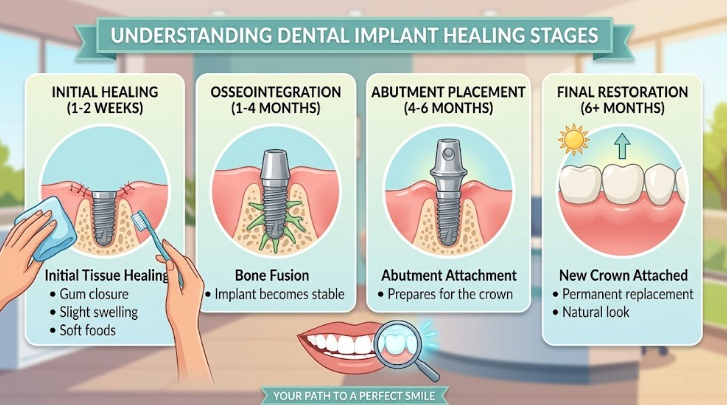
Are you planning to replace a missing tooth? If so, you are probably thinking about the dental implant healing stages. Most people think this journey is long and painful. Mainstream dental advice often makes the process sound scary. They tell you to prepare for months of suffering.
But here is a shocking truth: your body is built to heal much faster than standard clinics claim. You do not have to sit around in pain for half a year.
By understanding the true dental implant healing stages, you can take control of your recovery. This simple guide breaks down exactly what happens to your smile after surgery. We will look past the textbook medical jargon and give you a real, day-by-day map to a perfect smile.
What Happens Right After Your Surgery?
The very first of the dental implant healing stages starts the moment your dentist finishes the procedure. Many patients expect terrible pain on day one. However, the real challenge is actually swelling, not intense pain.
During the first 24 to 72 hours, your body rushes blood to your jaw. This causes your cheeks to puff up. Consequently, you might look like a squirrel hiding nuts. This is completely normal!
Conventional wisdom says to hide in bed and expect agony. The reality? True pain peaks early and fades fast.
To manage this early stage, use ice packs for 20 minutes at a time. Also, you must stick to very soft foods. Think smooth yogurt, applesauce, and lukewarm soups. Do not use a straw! The suction from a straw can pull away the important blood clot protecting your new implant.
What Do the Weekly Dental Implant Healing Stages Look Like?
Once you get past the first three days, your recovery speeds up. Let us look at how your mouth changes over the first month.
Week One: The Critical Window
By day four, your swelling should start to go down. Your gums will slowly turn from a bright red to a healthy pink. At this point, you can transition from ice packs to warm compresses. The gentle heat brings fresh blood flow to the area. This helps speed up the dental implant healing stages immensely.
Weeks Two to Four: Soft Tissue Repair
During this time, your stitches will either dissolve or be removed by your doctor. The visible wound closes up entirely. You will feel back to normal while doing everyday tasks. However, do not let this fool you. The most important work is happening deep beneath your gums where you cannot see it.
Why Is Osseointegration the Ultimate Healing Step?
This brings us to the most critical of all dental implant healing stages. Doctors call this phase osseointegration (the biological process where living bone grows and locks onto a titanium post).
To understand this easily, imagine building a house. You cannot build walls on top of wet cement. You must wait for the concrete to dry and harden completely.
- The Titanium Magic: Your body does not view titanium as a foreign object.
- The Microscopic Lock: Living bone cells actually grow directly into the tiny grooves of the implant post.
- The Final Result: The metal post becomes a permanent part of your jawbone.
This deep bone bonding takes anywhere from three to six months. It is the absolute foundation of your new tooth. If you rush this step, the implant will fail.
What Are the Warning Signs of an Implant Failure?
How do you know if your mouth is healing correctly? Most people worry about every little ache. Yet, true complications are actually very easy to spot if you know what to look for.
Signs of Healthy Progress:
- Swelling that goes away after three to five days.
- Gums that look light pink and feel firm.
- A total absence of throbbing pain after week one.
Red Alert Signs of Implant Failure:
- A dental implant post that feels loose or wiggles.
- A bad taste in your mouth or pus coming from the gums.
- A fever or swelling that gets worse after day four.
If you notice any of these red alert signs, you need to call a professional right away.
Quick Self-Assessment: Is Your Recovery on Track?
Are you wondering how well your mouth is adapting to your recent surgery? Take this quick, three-question check to see where you stand in the dental implant healing stages.
- How long ago was your surgery?
- A) Less than 3 days ago.
- B) 1 to 2 weeks ago.
- C) Over a month ago.
- What is your current pain level?
- A) Mild soreness managed easily with basic medication.
- B) Almost zero pain, just slight tenderness when touched.
- C) No pain at all.
- What can you comfortably eat right now?
- A) Only liquids and very soft purees.
- B) Soft foods like scrambled eggs, pasta, and fish.
- C) Regular foods, though I still chew on the opposite side.
Results: If you answered mostly A, you are safely in the initial recovery stage. Mostly B means your soft tissues are successfully repairing. Mostly C means you have safely entered the deep bone-fusing phase!
How Can You Speed Up Your Dental Implant Healing Stages?
Many dentists tell you to just sit back and wait. We disagree. You can actively assist your body to move through the dental implant healing stages much faster.
First, upgrade your nutrition. Your bone cells need specific materials to build new tissue around the metal post. Focus on foods high in Calcium and Vitamin D.
Second, avoid smoking at all costs. Smoking chokes off the oxygen supply in your blood. This can slow down your recovery or even cause your implant to fail completely.
Finally, practice perfect but gentle hygiene. Do not brush the surgical spot directly during the first week. Instead, use a warm saltwater rinse to keep bacteria away without disturbing the tissue.
The Ultimate Shortcut to Your Perfect Smile
Going through the dental implant healing stages does not have to be a guessing game. You do not deserve to spend months worrying about whether your bone is fusing correctly or if an infection is brewing.
You need a premium, concierge approach to dental restoration.
Our Elite Smile Restoration Program is built to fast-track your recovery. We reject the slow, outdated methods of standard clinics. By utilizing state-of-the-art biological mapping and custom post-operative recovery protocols, we optimize your body’s natural power to heal. This transforms a traditional six-month waiting period into a smooth, rapid transition.
Do not settle for generic care that leaves your dental health to chance. Claim your exclusive consultation today, and experience a life-changing smile transformation.